Danny wrote:Lee, where's your popcorn eating little guy?

Pascoscout makes some good points, especially about rasterizing, or grabbing the bearing lines from the full plat. However, that isn't as entertaining.

I still don't think this is actually impossible, and I'll line out why.
I don't believe that a four sided polygon, even if it's not a rectangle or parallelogram, has an infinite number of solutions that can keep the same area. A five sided polygon would be another story.
So......
Take the polygon, pick a diagonal and make two triangles.
*Note, I have really exaggerated the angles here to make it clear nothing is parallel, and that the side lengths are different.

Note that we don't know diagonal C, and we also don't know how the area is split between the two triangles. However, we don't need to know that beforehand, as diagonal C is the same on both triangles, and that makes it solvable.
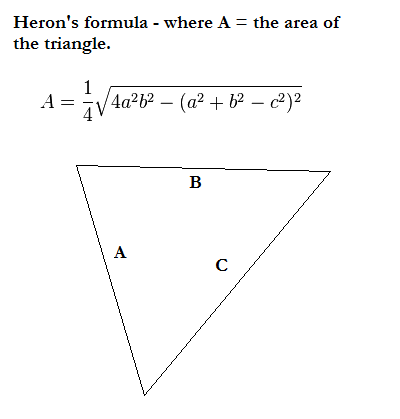
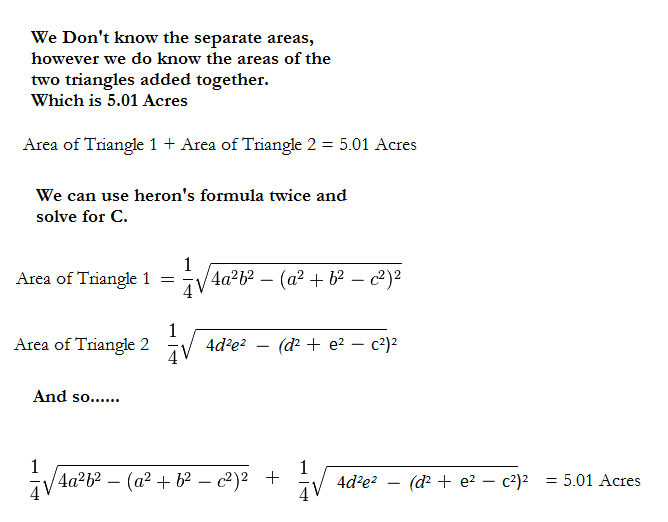
Once you plug in the numbers, and simplify things you end up with a quartic equation. What I was dumbly calling a quadratic to the 4th power. There are probably going to be two answers, but only one is real.
After sitting and thinking about this on the drive in to the meeting, I started remembering a bit of the old math. I think quartic equations that are not bi-quadratics were covered in the last week of math class, which I probably slept through.
I may look up how to solve the math part of this tomorrow. I think you end up using cubic formulas, but really don't remember well enough.
So what do you guys think? I'm I missing something glaringly obvious? Bored to tears?