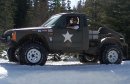
Ace_Cherokee wrote:OldGreen wrote:If I was going to do this, I would do a few things:
1. strip out the drivetrain, measure for the hole and plate everything.
2. Then gusset the places you plated.
3. Then build a structural space frame/roll cage. Doesn't have to be complex. Luckily, the same shapes that absorb impact are good at resisting torque as well.
4. Stretch the front end out a few". It is truly amazing what just a little front end stretch will do for stability. Since you said you were going to do a long arm set-up anyway, just do it FIRST. You will need to have an engine cage since you don't have frame rails, so mounting the coils and/or coilovers farther forward wouldn't be a big deal.
5. Trussed front axle of the D44 variety or a stock D60. The 44 would likely be fine since you said you won't wheel it much. Stock gearing like 3.73 would work just fine. ..
6. I'd stop believing what I read on the internet. . .the stock radiator needs to be upgraded.
7. Match the rearend to the front (14 bolt, D60, etc.)
8. Measure everything 22 times.
:
Originally Posted by Goat View Post
1. Huh?
2. Gussets/Fishplates are a tad overkill if you choose to plate the unibody rails.
3. That's a judgement call.
4. Perhaps, this falls on "what is the perfect wheelbase" argument.
5. Depends on the axle you source. If it's a 3/4T D44 then the tubes are thick enough. Just gusset the inner C's.
6. No, the stock rad is plenty.
7. Duh.
8. Yes!!! And do this before you start cutting into anything. The front is spring out of shape if you cut out the core support, I know this from experience.
1. He didn't understand the statement. I was actually just saying that if you are going to move the motor back in the chassis, that you should make sure to measure everything prior to firing up the welder. . .including TCase clearance, driveline length based on rear axle choice and position, etc.
2. True. Judgement call based on how you want to use it. There is no such thing as overkill.
3. Again, agreed. Judgement call. You have to decide if it is good judgement or not.
4. While "Goat" has a good grasp on fabrication and mechanics, "what is the perfect wheelbase" had nothing to do with it in this case. It was about weight distribution. Not only that, but it would allow you to drop the engine in the bay a little more.
5. The only argument I have here is that the wheel bearings are a lot beefier on a bigger axle, but the D44 with a proper gusset/truss or the HD44 would probably work fine. Just more compromises. . .
6. OK. But, if I am doing a full drivetrain swap, I'd at least get a high performance stock replacement. Engines are expensive and heat kills them.
7. You'd be amazed at the number of mismatched front/rears I have seen over the years. There are also a lot of people running around in 4x4s with no front drivelines. . .it is a "DUH", but again, common sense isn't that common.
8. . . .and you may be able to weld in a temporary cross member if you have to cut out the core support and the front stock cross member.
One more thing that is directly in my wheelhouse: Tire size. I would imagine that you are going to increase the weight of your Jeep by about 30 to 40% between the new components and all of the steel for reinforcement. Off-road tire performance is all about contact pressure and traction. Any gnarly treaded tire provides traction, but contact pressure is a function of the size of the contact patch at a given psi and the weight of the vehicle. THIS is THE secret sauce to the wheelin' world.
So, to expound: The size of the contact patch is determined by 4 things
1. The weight of the vehicle
2. The Diameter (actually circumference) of the tire
3. The width of the tire.
4. PSI
It is pretty tough math to figure out the exact size of the patch at a given PSI, but you can use a ratio. If you want to have the same amount of floatation as your current set up and the width of the tire is going to be a constant 12.5", you can do the following to get close:
Old Weight:New Weight = Old Tire: New Tire
or, since we don't know the EXACT weights, we can use approximate percentages:
100%:125% = 33:New Tire
So New Tire = 33x1.25= 41.25 rounded up to a 42x12.50 at the SAME PSI. The good news is that a bigger tire is better off at a lower PSI. . .so, you could probably get away with a 37 or 38" tire and have a similar wheelin' experience to your current 33s if you keep the weight gain to around 1000lbs or less.
I know you said that you don't wheel much, but this is the kind of crap that I have swimming around inside my head. I just can't help it. Plus, you probably don't want to end up being worse off on the trail than you are now the few times you go out.
For the record, I dig that goat guy's build. . .

 keep at it and keep us updated. If I had the money and know-how I'd be doing the same thing. I love diesels. I tried to stuff a diesel into my camaro "because I wanted to." The plan ended up not working due to the turbo design/mount. But if I ever get my hands ona 6.5 with a blower its going to be in my camaro in a heart beat.